When we talk about "special needs for autism," what we're really describing are the unique and varied supports a person on the spectrum needs to truly thrive. These aren't limitations. They're simply distinct ways of processing the world, whether that's in communication, social situations, sensory perception, or learning. The key is to meet these needs, because that's how we unlock an individual's full potential.
The first step is to reframe what "special needs" even means. Instead of seeing them as deficits, think of them as specific adjustments an individual needs to feel more in sync with their environment. It’s a bit like tuning a musical instrument—each person requires just the right adjustments to play their best song. This guide will walk you through identifying these core needs and then putting effective, real-world strategies into place.
There's a real urgency to get this right. The number of children identified with autism has grown significantly. In fact, 2022 data showed that 1 in 31 children in the U.S. has been identified with autism spectrum disorder. That's a huge 382% increase since 2000, and it really highlights how important accessible, high-quality support is for a growing number of families. You can find more details on this trend over at Motivity.net.
The word "spectrum" is so important here because it reminds us that no two autistic individuals are the same. Their needs can range from mild to significant and can look very different across various areas of their life.
Understanding the special needs for autism means recognizing that support must be as individual as the person receiving it. A one-size-fits-all approach rarely works; instead, success lies in creating a personalized toolkit of strategies, therapies, and accommodations.
This spectrum also includes people who might not show obvious outward signs of a disability. Our guide on the characteristics of high-functioning autism can offer more insight into just how diverse these presentations can be. Ultimately, your goal should be to build a supportive ecosystem—at home, at school, and in the community—that empowers each person to navigate the world with confidence.
To create a truly effective plan for an autistic individual, we first have to understand the landscape. Think of it like mapping out a unique territory—knowing the key areas where support is most needed helps us build a sturdy, reliable path for growth. Autistic individuals simply process the world differently, and that shapes their experiences in communication, social interaction, sensory perception, and learning.
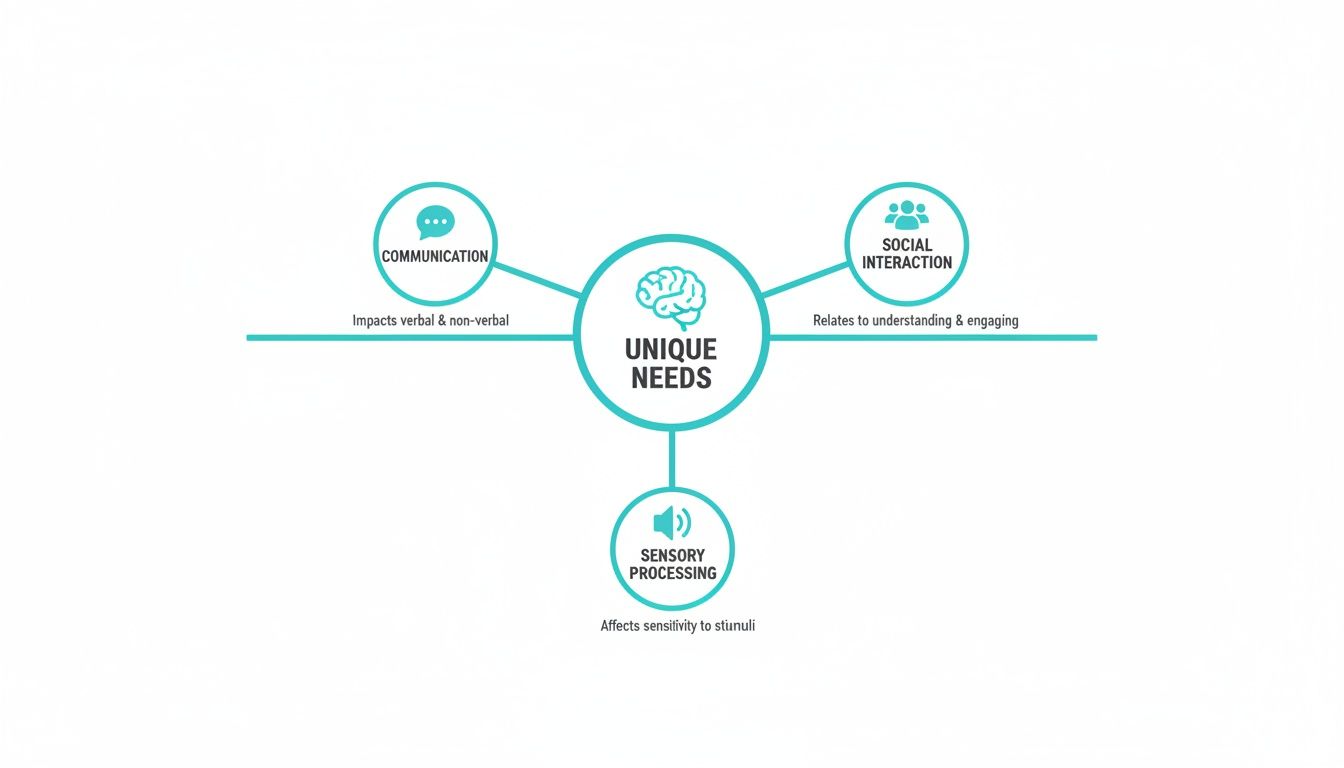
Let's look at how these core areas connect.
As you can see, things like communication, social understanding, and sensory processing are central pillars. They all stem from a distinct neurotype, creating a profile of needs that is unique to each person.
When we talk about communication, it's so much more than just spoken words. It's about picking up on non-verbal cues—the subtle shifts in tone, facial expressions, and body language that many neurotypical people process without a second thought. An autistic person might take a sarcastic comment at face value or find it incredibly difficult to figure out how to start a conversation.
In the same way, navigating social situations can feel like trying to play a complex game without ever being told the rules. These unwritten social expectations, like how much eye contact is "right" or how to join a group of kids on the playground, can be baffling. Your support should focus on making those hidden rules clear and explicit.
Sensory processing differences are one of the most common—and often misunderstood—aspects of autism. Imagine walking through the world with the volume dial stuck on high. Bright lights feel like spotlights, quiet background noises sound deafening, and a gentle touch can feel jarring or even painful. This is what we call hypersensitivity.
On the flip side, some individuals experience hyposensitivity. They might need more sensory input just to register it. You might see a child who seeks out strong flavors, craves deep-pressure hugs, or needs to be in constant motion to feel grounded and regulated. Helping a child manage their sensory environment is absolutely crucial for preventing overwhelm.
It's so important to remember that behavior is often communication in disguise. A meltdown isn't a "tantrum" meant to manipulate; it's frequently an involuntary response to severe sensory overload or a desperate attempt to communicate a need they can't put into words.